
After doing hundreds of residential security assessments across Brisbane, I’ve seen the same problems come up again and again. Not because homeowners are careless — most people who invest in cameras and alarms are genuinely trying to protect their families — but because the advice they’ve received, often from hardware stores or general electricians, doesn’t reflect how break-ins actually happen.
Here are the issues I find most often, and what to do about them.
Cameras That Only Cover the Front
The most common layout I see is two or three cameras covering the driveway and front door, with nothing at the rear. QLD Police crime data consistently shows that rear and side access points — back gates, side passages, rear fences — account for the majority of residential break-in entry points in Brisbane. A camera that’s pointing at the street while someone climbs your back fence isn’t providing security, it’s providing the appearance of security.
A properly designed system covers all realistic entry points, not just the visible ones from the footpath. For most Brisbane houses that means at minimum: front door, driveway, side gate, rear yard, and any secondary access to the garage.
Cameras Mounted Too High
There’s an instinct to mount cameras up high — under the eaves at full height, up on the corner of the roofline — because it feels secure and they’re harder to reach. The problem is that face identification at 6 metres or more becomes extremely difficult, even with good resolution. Footage from a camera mounted at 4–5 metres pointing down at a 45-degree angle will show you the top of someone’s head. That’s useful for general movement tracking, not for identifying anyone.
We mount cameras at the height that captures usable face-level footage at the likely point of approach — typically 2.5 to 3.5 metres, angled to capture a clear image of anyone entering through a doorway or gate. Security coverage isn’t just about recording that something happened. It’s about recording footage that’s actually useful.
No Consideration of Night Performance
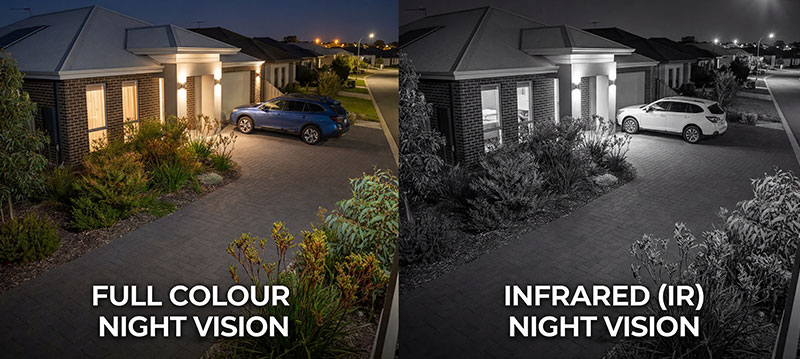
Most break-ins happen at night, which means your camera’s ability to capture useful footage after dark is arguably more important than its daytime performance. Budget cameras often use basic infrared illumination that washes out the foreground and produces grainy, low-contrast footage beyond 5 metres. Colour night vision cameras use a small amount of ambient or supplemental white light to produce full-colour footage in near-darkness, which is significantly more useful for identification.
If you haven’t tested your cameras in complete darkness at 10–15 metres, you may not know what you’re actually getting when it matters. We always review night performance as part of commissioning and make sure clients understand what their cameras can and can’t do.
Recorders With No Off-Site Backup
An NVR that’s sitting under the TV in your living room is the first thing someone takes when they break in. If your footage is only stored locally on the recorder, and the recorder is stolen, you have no footage of the people who stole the recorder. This is the single most common situation we see when people call us after a break-in asking if they can recover their footage.
The solution is off-site backup — either cloud storage for key event clips, or a second recorder in a secured, non-obvious location. Even a 24-hour rolling backup of motion events off-site is enough to ensure you have usable footage regardless of what happens to the primary recorder.
No Alarm System to Back Up the Cameras
Cameras record. They don’t respond. If someone enters your home and your only security system is cameras, the only consequence is that footage exists — footage that may or may not lead to a prosecution, at some point in the future. An alarm system, particularly one that’s monitored, creates an immediate consequence: noise, attention, and a response that arrives in minutes rather than days.
Most of the homes that call us after a break-in had cameras but no alarm. Most of the homes that have both have either had no incidents, or the alarm triggered early enough that the intruder left before completing the entry. The two systems work together — cameras provide evidence, alarms create response. Neither is a substitute for the other.
Get an Honest Look at What You Have
If you’ve got a system installed and you’re not sure whether it actually covers what it needs to cover, Jarrod will do a free assessment and give you a straight answer. No obligation, no sales pressure. Call 0490 130 339 or use the contact form on this site. We cover Brisbane, the Gold Coast, and the Sunshine Coast.