Brisbane Security Compliance — QLD Licensing, ASIAL & Privacy Law Explained
Every legitimate security installer in Brisbane has to satisfy three separate compliance regimes: state licensing (Queensland Security Provider Act 1993), industry accreditation (ASIAL membership), and privacy law (Privacy Act 1988 + state-level Information Privacy Act for CCTV deployments). If your installer can’t tell you their position on all three, walk away.
I’m Jarrod Edwards, owner of Mr Secured Pty Ltd. This page is the plain-English version of what those compliance regimes actually require, what the consequences look like, and how to check that your installer is real.
1. Queensland Security Provider Licence
Under the Security Providers Act 1993 (QLD), anyone who installs, repairs, services, or commissions a security system for reward must hold a current Security Provider Licence issued by the Office of Fair Trading. There are 4 classes; CCTV and alarm installers fall under Class 2 — Security Equipment Installer.
| Licence class | Covers | Penalty for breach |
|---|---|---|
| Class 1 – Crowd Controller / Security Officer | Bouncers, guards, patrol | Up to $26,690 (200 penalty units) |
| Class 2 – Security Equipment Installer | CCTV, alarm, intercom, access control | Up to $26,690 + voided warranty + insurance claim refusal |
| Class 3 – Security Equipment Repairer | Service / repair only | Up to $26,690 |
| Class 4 – Security Adviser | Consultancy, risk audit | Up to $26,690 |
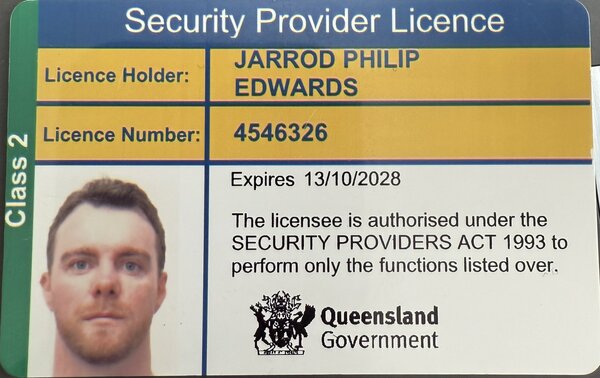
Mr Secured holds Class 2 Security Provider Licence #4546326 — search the QLD Security Provider register at publications.qld.gov.au/security-providers to verify any installer claiming a QLD licence.
What happens if your installer is unlicensed
Three real consequences, not theoretical: (1) Your home insurance can refuse to pay out if a CCTV/alarm system installed by an unlicensed party was relevant to a burglary or fire claim. (2) Your warranty is void — manufacturers like Dahua, Hanwha, and AJAX only honour warranty when installed by an authorised, licensed installer. (3) The Office of Fair Trading actively prosecutes — Queensland has issued 60+ fines in the past 3 years.
2. ASIAL Membership
The Australian Security Industry Association Limited is the industry peak body. Membership is voluntary but signals: (a) the installer agrees to the ASIAL Code of Professional Conduct, (b) holds minimum $20M public liability + $5M professional indemnity insurance, (c) submits to dispute resolution if a customer complains, (d) commits to ongoing professional development.
Mr Secured is an ASIAL member. Verify at asial.com.au/Find-A-Member.
3. Privacy law — what you legally can and can’t record
For residential CCTV deployments in Queensland, three privacy considerations matter:
Audio recording is strictly limited
Under the Invasion of Privacy Act 1971 (QLD), recording audio of a private conversation without consent is an offence — even on your own property if the conversation isn’t intended for you. Default position: leave audio off on all cameras unless you have explicit consent. Most professional installers disable mic by default; many DIY kits ship with it on.
Cameras must not capture neighbours’ private spaces
Domestic CCTV is not regulated by the Office of the Australian Information Commissioner (OAIC) for purely personal use. However, civil action (nuisance, harassment, trespass-by-surveillance) is possible if cameras are positioned to view a neighbour’s pool, bedroom window, or yard. Best practice: angle cameras to your own boundary or use privacy-mask zones in the NVR.
Commercial premises require signage
If you’re installing CCTV in a commercial premises in Brisbane — retail, hospitality, office — you must display signage at every public entrance under the OAIC’s CCTV guidance. Wording template: “CCTV in operation for security purposes. Footage may be retained for up to 30 days.” Mr Secured supplies AS-compliant signage with every commercial install.
4. Insurance compliance — what your home insurer needs
Most QLD home insurers (RACQ, Suncorp, Allianz, NRMA) offer a discount of 5–15% if you can certify a “monitored alarm system installed by a licensed provider.” To claim the discount, you typically need:
- Installer’s QLD Security Provider Licence number
- Certificate of installation (we issue this on completion)
- Monitoring contract details if monitored response is part of the policy
- System specification including standard (e.g., AS/NZS 2201.1 for intruder alarms)
If your installer can’t produce all four, your discount can be retroactively voided.
5. Standards your install should reference
For Brisbane homes and businesses, the standards that actually matter:
- AS/NZS 2201.1:2007 — Intruder alarm systems for buildings
- AS/NZS 4806 — Closed circuit television (the 4-part CCTV standard covering planning, transmission, recording, and image quality)
- AS/CA S009:2020 — Customer Cabling Provider Rules (required for any cabling that connects to the telecommunications network)
- Wiring Rules (AS/NZS 3000) — relevant for any 240V power install (must be performed by a licensed electrician, not a security installer alone)
How to verify your Brisbane installer
Three searches, three minutes:
- QLD Security Provider register — publications.qld.gov.au/security-providers — enter installer name, get current licence status.
- ASIAL Member directory — asial.com.au/Find-A-Member — confirms current membership and insurance coverage.
- Public liability certificate — ask for a current Certificate of Currency, $20M minimum. Real installers email this within 5 minutes; fake ones go quiet.
FAQ
Do I need a QLD Security Provider Licence to install CCTV on my own home?
No. The licensing requirement only applies to installation for reward (paid work). Homeowners can install CCTV on their own property without a licence, subject to the privacy and audio rules above.
What’s the difference between QLD and federal security regulation?
State law (QLD Security Providers Act) regulates the installer/business. Federal law (Privacy Act 1988) regulates how footage is handled — applies mainly to commercial deployments. Both apply to commercial installs in Brisbane.
Is ASIAL membership mandatory in Brisbane?
No, it’s voluntary. But ASIAL membership signals professional standards, insurance compliance, and dispute resolution access. Insurance providers often weight ASIAL membership in their installer-approval lists.
What if my installer’s licence has expired?
Any work performed under an expired licence is technically unlicensed. Your warranty, insurance position, and recourse for defects are all weakened. Verify current licence status before signing off on the job.